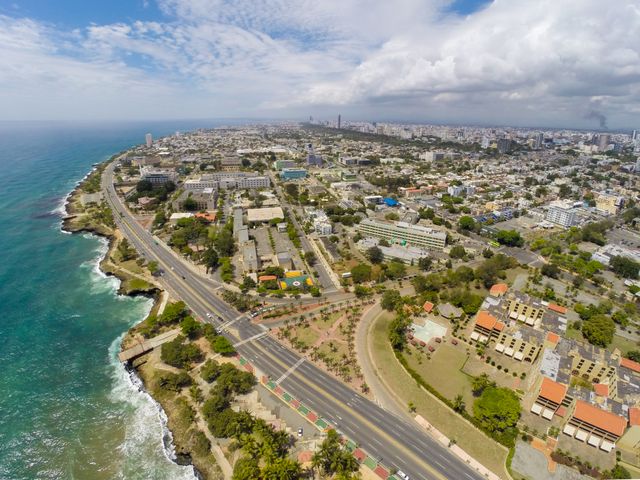
Santo Domingo
The Caribbean’s biggest city — for people who want real-city living and to stay close to home.
Monthly cost
$1,200–2,000
comfortable, one person
Time zone
Atlantic (UTC−4)
≈ US East Coast
Climate
Hot & humid
AC year-round
Best for
Real-city living,
close to home
If the cheap-living lists keep handing you sleepy towns and beach resorts, Santo Domingo is the other kind of option: a full-size Caribbean capital of more than three million people, with real hospitals, a working metro, international malls, and direct flights home. It’s about two and a half hours from Miami and runs on roughly East Coast time, so it’s built for the person who wants an actual city and wants to stay close to home rather than disappear into a small town. The private healthcare is a genuine draw — the DR is a medical-tourism destination in its own right — and daily costs land well below what you’d pay in a comparable US city. But it’s hot and humid, the traffic is real, and the country has complexities an honest guide has to name. Here’s the honest picture before you decide it’s yours.
Why people choose Santo Domingo
What’s genuinely good
- It’s a full-size city with the infrastructure to match — a working metro, international malls and restaurants, over three million people — rather than a resort or a nomad bubble.
- The private healthcare is a standout. The DR is a recognized medical-tourism destination, with internationally accredited hospitals and English-speaking doctors, at a fraction of US prices.
- You stay close to home: about two and a half hours from Miami, direct flights to major US cities, and roughly East Coast time, so work and family don’t drift out of reach.
- Daily costs sit well under a comparable US city, and US dollars are widely accepted in the expat neighborhoods — though you’ll do better paying in pesos day to day.
- There’s a settled expat corridor with the logistics already mapped — modern buildings, walkable streets, and the best hospitals close by.
What you’re signing up for
- It’s hot and humid all year. Air conditioning runs year-round here, so put it in your budget from day one rather than treating it as an extra.
- The traffic is genuinely bad. Rush hour can double a trip, so a fixed daily schedule takes more planning than you’d expect.
- Safety is neighborhood-dependent. The expat areas are comfortable and the country’s overall US advisory sits alongside places like France and Germany, but the gap between neighborhoods is real, and habits like taking Uber over street taxis matter.
- Infrastructure outside premium buildings can wobble — power and water aren’t always steady — so confirming a building’s backup generator before you sign a lease is a normal step here.
- The country carries real complexities: a fast-moving property market with heavy foreign investment, and ongoing strain from regional migration on public resources. Daily expat life is largely insulated from both, but an honest look has to name them.
The honest cost picture
A comfortable month for one person in Santo Domingo runs roughly $1,200 to $2,000. That’s real-city pricing that still lands well under a comparable US metro. Where you fall inside it depends mostly on your neighborhood and rent — the expat corridor costs more, quieter residential areas noticeably less — and remember that air conditioning runs all year, so utilities are a real line rather than an afterthought.
$1,200–2,000 / month · one person, comfortable
That’s the honest range — enough to know whether Santo Domingo belongs on your list. Where you actually land depends on your rent, your neighborhood, and how much city life you want on your doorstep.
What the toolkit adds for Santo Domingo
- The full itemized monthly breakdown — rent, groceries, transport, healthcare and insurance
- The neighborhood read — the expat corridor versus the quieter, cheaper residential areas, what each costs and how safe each feels
- The complete GF/DF read, the visa and residency specifics, and the honest downsides in full
- A calculator that runs your own current spending against Santo Domingo
- The week-by-week plan — plus eleven more cities
Eating gluten- and dairy-free in Santo Domingo
Dominican food is naturally friendly to gluten-free eaters — rice, beans, plantains, root vegetables and grilled meats carry the traditional plate, and la bandera, tostones, yuca and sancocho are all naturally safe. Dairy is where it gets trickier here. Milk turns up more than in a lot of Latin American cooking — in desserts, coffee drinks, and some sauces, with cheese and butter in certain dishes — so eating dairy-free means asking, especially at local spots. The upside of a full-size city is the shelves: supermarkets in the expat neighborhoods carry oat and almond milk and a growing range of specialty products, so stocking a dairy-free kitchen is straightforward even when the restaurant side takes more care. Naturally GF-leaning, with dairy the part to plan around.
Healthcare, safety, and staying legal
Healthcare is one of the real reasons people pick Santo Domingo — the DR is a medical-tourism destination, with internationally accredited private hospitals and English-speaking doctors, and everyday care at a fraction of US prices; quality in the private system runs from very good to excellent. Safety is neighborhood-dependent: the expat areas are comfortable, the country’s overall US advisory sits at the same level as several Western European countries, and sensible habits — Uber over street taxis, well-lit areas at night — go a long way. On staying legally, US citizens enter without a visa for a short tourist stay that can be extended, and there’s a retirement-residency route for the long term.
The exact entry and extension limits, the residency income thresholds, the hospital and insurance specifics, and the neighborhood-level detail are in the toolkit, because those are the parts worth getting exactly right rather than guessing.
See what a month in Santo Domingo would really cost you
The full Santo Domingo guide inside the toolkit gives you the itemized breakdown, the neighborhood-by-neighborhood detail, the visa and residency specifics, and a calculator that runs your own budget against it — plus eleven more cities and a week-by-week plan.
Get the toolkit — $47Not sure Santo Domingo’s your city yet? Take the 2-minute quiz or run your number through the cost calculator first.
Cost figures are total monthly estimates for one person and vary by neighborhood and lifestyle. They’re starting points for your own research, not guarantees. Entry and residency rules change — verify current tourist-entry, extension, and residency requirements with your nearest Dominican consulate or a licensed Dominican immigration attorney before applying.